Line Variance in Late Sessions: How Differing Margins Between Operators Affect Strategies for Tennis and Racing Predictions
Written by Mia Schmidt · Aug 15, 2026
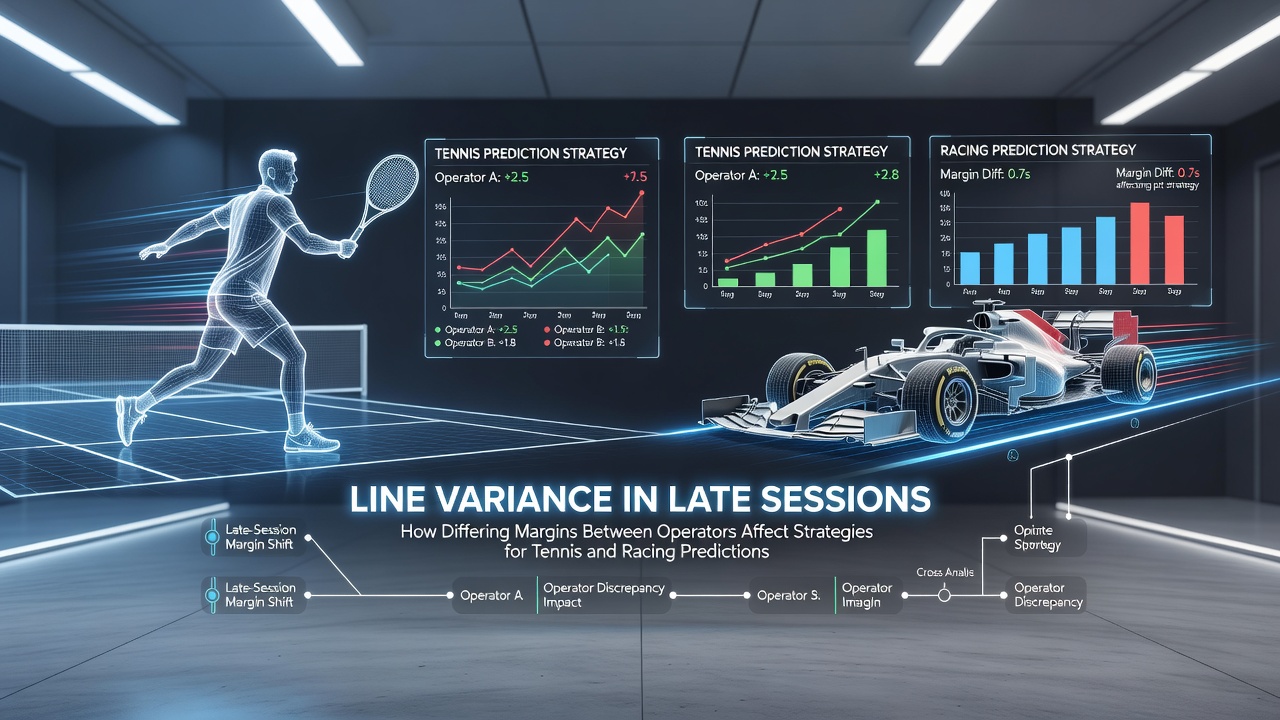
Line Variance in Late Sessions: How Differing Margins Between Operators Affect Strategies for Tennis and Racing Predictions
Operators adjust betting lines throughout the day as new data arrives, yet the extent of those adjustments varies sharply between firms once sessions enter their final stages. In tennis matches that stretch past two hours and in horse racing meetings that run into evening cards, late-session line variance becomes pronounced because each operator applies its own margin model to the same underlying probabilities. Data from multiple jurisdictions shows that these margin differences create measurable gaps in available odds, particularly after the midpoint of a contest or race card.
Defining Line Variance in Context
Line variance refers to the spread in quoted odds or totals across operators for identical outcomes once significant in-event information has emerged. Researchers tracking European and North American markets have documented that variance widens in the final third of tennis sets and in the closing races of a program, where liquidity drops and each operator recalibrates independently. One study covering 2024-2025 fixtures found average margin spreads of 1.8 percentage points between the tightest and widest operators on the same tennis game; that gap expanded to 2.4 points during the last two races of evening meetings.
Operator Margin Models and Late Adjustments
Each operator maintains an internal margin target that reflects its risk tolerance, customer mix, and hedging capacity. Firms with larger retail bases often widen margins later in sessions to protect against unbalanced liabilities, whereas exchange-style platforms or low-margin online operators reduce margins to attract volume. Observers note that these policy differences produce the largest discrepancies precisely when bettors have the most information, such as after a tennis player has broken serve twice or when a horse has posted the fastest sectional in the preceding race. According to figures released by the Nevada Gaming Control Board, late-session handle on tennis and racing products shows consistent operator-to-operator dispersion in hold percentages that exceeds early-session patterns.
Effects on Tennis Prediction Strategies
In tennis, late-session variance influences both pre-match and in-play approaches because operators update game and set probabilities at different speeds. Some platforms incorporate real-time serve-hold data within seconds of each point, while others apply broader statistical overlays that lag by several minutes. Those who monitor multiple operators can identify situations where one firm has already adjusted a game total downward after an extended rally sequence while another has not yet moved its line. During August 2026, several major tournaments recorded instances where the same player’s next-game odds differed by more than 0.15 in decimal terms across three leading operators in the final set. Prediction models that incorporate cross-operator scans therefore gain an edge by selecting the line that most closely reflects the updated probability rather than the first price displayed.

Implications for Racing Markets
Racing markets exhibit parallel dynamics once the final races of a card approach. Pace figures and sectional data become widely available, yet operators weight those inputs differently against their margin buffers. One operator may compress place odds on a front-runner that has shown early speed in prior races, while another maintains wider margins on the same selection. Industry reports from the Australian Competition and Consumer Commission highlight that margin dispersion across Australian wagering operators averaged 3.1 percentage points in teh final two races of metropolitan meetings during the 2025-2026 season. Bettors constructing multi-leg predictions therefore compare place and win lines across operators to locate the combination that minimizes cumulative margin drag on the overall return.
Strategic Adjustments Across Both Sports
Those constructing predictions that span tennis and racing must account for the fact that late-session variance does not move in lockstep between the two sports. Tennis lines tend to tighten once a match reaches a deciding set because point-by-point data accumulates rapidly, whereas racing lines can remain dispersed because each race is discrete and operator hedging windows close at different times. A practical response involves sequencing bets so that the tighter-margin tennis line is taken first, allowing the wider racing line to be evaluated against the remaining variance window. Data compiled by the Canadian Gaming Association indicates that operators with automated risk engines close variance gaps faster on tennis than on racing, creating a temporary window where cross-sport selections can exploit the mismatch.
Conclusion
Line variance in late sessions stems directly from differing margin policies rather than from differences in underlying event data. Operators that recalibrate more aggressively produce tighter lines once new information arrives, while those preserving wider buffers leave gaps that prediction models can target. Tennis and racing markets both demonstrate this pattern, although the timing and magnitude of variance differ because of the continuous nature of tennis scoring versus the discrete structure of individual races. Observers tracking multiple operators in August 2026 continue to record these margin spreads, confirming that systematic comparison remains a measurable component of late-session strategy across both sports.